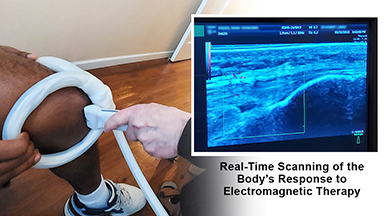
FUNCTIONAL IMAGING CONFIRMS THERAPEUTIC RESPONSE
One of the most comprehensive ways to confirm the results of any treatment is by clinically tracking the body's physiological response from underneath the skin. Functional Diagnostic imaging captures measurable data about the injured or inflamed area, allowing both clinicians and patients the ability to identify therapeutic progress in real time. Widely preferred scanning modalities include the Doppler Blood Flow Ultrasound (or sonography) and Elastography, both using high-frequency sound waves to view inside the body. Like an internal video camera, these high speed scanning innovations capture actual movement of the body's internal organs. This offers a vast amount of biometric information about the patient’s condition, in comparison to still images of conventional x-rays. The ultrasound's ability to evaluate abnormalities within the soft tissue in research and clinical trials are widely used in recording evidence-based biomarkers to trace therapeutic efficacy.
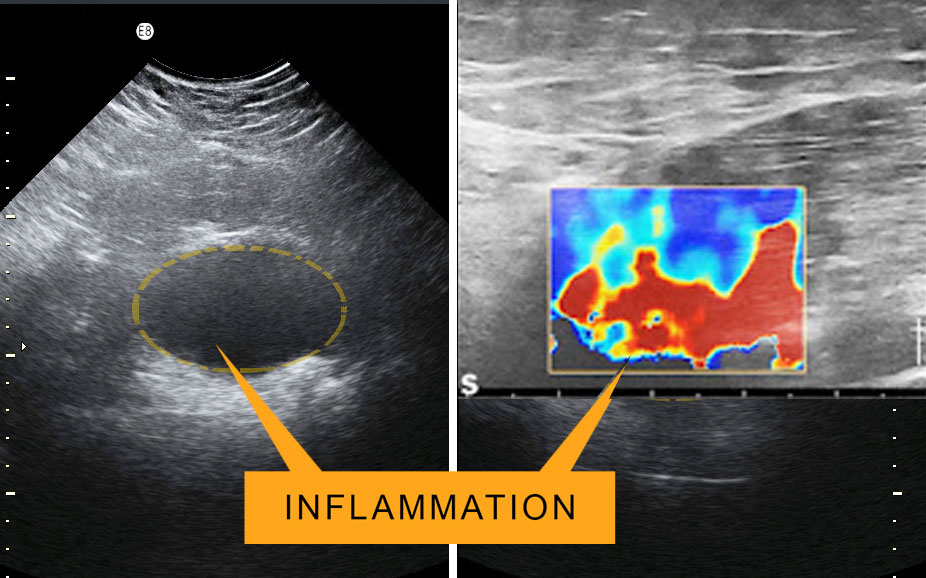 |
DETECTING INFLAMMATION: Part of the complex biological response of body tissues to harmful stimuli (such as pathogens, damaged cells, or irritants) is inflammation. It is also a protective response involving immune cells, blood vessels, and molecular mediators. Detecting the function of inflammation allows us to eliminate the initial cause of cell injury, clear out necrotic cells and tissues damaged from the original insult and the inflammatory process, and initiate tissue repair. The five cardinal signs are heat, pain, redness, swelling, and loss of function. Inflammation is a generic response, and therefore it is considered as a mechanism of innate immunity. Too little inflammation could lead to progressive tissue destruction by the harmful stimulus (e.g. bacteria) and compromise the survival of the organism. In contrast, too much inflammation, in the form of chronic inflammation, is associated with various diseases, such as hay fever, periodontal disease, atherosclerosis, and osteoarthritis.
ACUTE inflammation is the initial response of the body to harmful stimuli from the blood into the injured tissues. A series of biochemical events propagates and matures the inflammatory response within the injured tissue. Prolonged or CHRONIC inflammation, leads to a progressive shift in the type of cells in the inflamed area and is characterized by simultaneous destruction & healing of the tissue from the inflammatory process.
ADDRESS THE STRESS
Analyzing STRESS & ANXIETY from a holistic point of view means identifying the body’s interconnected systems (ie. circulatory, cardiovascular, nervous, lymphatic, endocrine etc.) and its many touch points for stimulation. This analysis should also offer a comprehensive breakdown of the body's HEALING capacity- which includes our hormones, digestive system, immune system, brain, heart-- all the way down to our cells and mitochondria. Stress is part of life, and comes in many forms including physical, emotional, mental and environmental. Foods we eat, unhealthy relationships, difficulties at work, toxins in our environment, even poor posture or lack of sunshine can all create stress on our bodies. But when stress is catastrophic or becomes chronic, it creates imbalances in this functioning that are much more likely to promote disease while at the same time preventing healing from taking place.
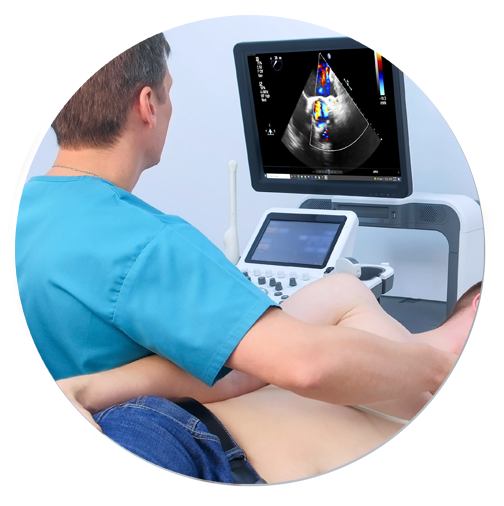 IDENTIFYING TREATMENT EFFICACY: How much effect is your medicine actually having on the body? This level of clinical reporting provides findings on the immediate physiological effects of any therapeutic solution. Results can be based on a BEFORE‐AND‐AFTER visual response comparison, quantifiable biometrics and a sound description of the clinical imaging ‐ thus aiming to show the body's potential reaction to that device (if any) by virtue of a post‐treatment applied scan. Imaging provides scan studies designed to assess, confirm or challenge (if necessary) any device's claims to confirm the device’s impact on the body. Measurable evidence reports can be conducted through the use of advanced ultrasound scans who seek real-time evidence-based valuation. IDENTIFYING TREATMENT EFFICACY: How much effect is your medicine actually having on the body? This level of clinical reporting provides findings on the immediate physiological effects of any therapeutic solution. Results can be based on a BEFORE‐AND‐AFTER visual response comparison, quantifiable biometrics and a sound description of the clinical imaging ‐ thus aiming to show the body's potential reaction to that device (if any) by virtue of a post‐treatment applied scan. Imaging provides scan studies designed to assess, confirm or challenge (if necessary) any device's claims to confirm the device’s impact on the body. Measurable evidence reports can be conducted through the use of advanced ultrasound scans who seek real-time evidence-based valuation.
|
CLINICAL RESEARCH PROJECTS
The concept behind PERFORMANCE TESTING underscores the core commitment of any health-related product to “ensure that health or medical devices shall consistently and safely provide the effects and benefits they are intended. Dr. Robert Bard (NYC) officially drafted an official update to his blueprint coordinating clinical monitoring and validation of non-invasive devices through diagnostic imaging protocols (under Institutional Review Board approved through HHS and FDA regulations). The primary monitoring and biometric reporting research protocol employs the use of medical grade 3D Doppler Ultrasound imaging, Elastography and other non-radiation based imaging solutions. (PDF:see details)
 |
RESEARCH PROJECT: DENSE BREAST IN ATHLETIC COMMUNITY-
9/22/2021- For women with any level of breast density, one of the major concerns is the alarming rate of false positives that may align with cancers missed by a mammogram. The other concern is that women with dense breasts have a naturally higher risk of breast cancer than women with fatty breasts, and the risk increases with increasing breast density. (This increased risk is separate from the effect of dense breasts on the ability to read a mammogram.). The main focal points of this research project covers the diagnostic study of ATHLETIC WOMEN or those with LOW BODY MASS INDEX (bet 12-22% body fat).
ACTIVE SURVEILLANCE
Where Recurrence Prevention Scans are implemented after cancer treatment or surgery, Active Surveillance is often recommended once you are diagnosed of an early stage cancer- one that is identified as slow-growing such as prostate, breast, kidney, and thyroid cancer. Monitoring cancers during its very early stages (instead of immediate treatment) may be a good option. This means closely watching a patient’s condition but not giving any treatment unless there are changes in test results that show the condition is getting worse. Active surveillance may be used to avoid or delay the need for treatments such as radiation therapy or surgery, which can cause side effects or other problems. During active surveillance, certain exams and tests, such as blood tests, imaging tests, and biopsies, are done on a regular schedule to monitor the condition. Active surveillance may be used in certain types of prostate cancer and in some other types of cancer. It is a type of expectant management. (See complete report)
Contributing to the evolution of SCIENCE
by: Dr. Robert L. Bard
 |
I welcome all solutionists and innovators who support the healing arts community. I have devoted my specialized work to pursue the advancement of MEDICAL RESEARCH with NON-INVASIVE SURROGATE ENDPOINTS with the hopes of contributing my talents to the performance of your current and future projects. With over 45 years in the field of advanced diagnostic science, my life's work has been about the clinical examination and targeted analyses of all subdermal disorders using the latest quantifiable digital imaging innovations. I have established an entire foundation dedicated to Medical Research committed originally to the exploratory studies of all cancer treatment proctocols. Alongside this, I have also been most active in collaboration with some of the top treatment strategists, health centers, clinical labs, experimental / alternative treatment professionals and medical device manufacturers. I have earned a reputation for my investigative approach within various examination paradigms including progress monitoring and surveillance.
As a CO-INVESTIGATOR, I have the greatest interest in supporting all entities committed to contributing technical innovations and new advancements in treatment solutions for our medical community. By this, I wish to build a partnership with establishing research teams to conduct clinical test projects where my talents to support visual reporting through imaging to be a priceless benefit to your overall objectives. Most research sponsors and medical developers' testing and tracking needs often fall into one of a number of common task categories- all within the objectives of public health, safety and healthcare support. I look forward to learning about your project with the hopes of supporting your needs and objectives.
|